


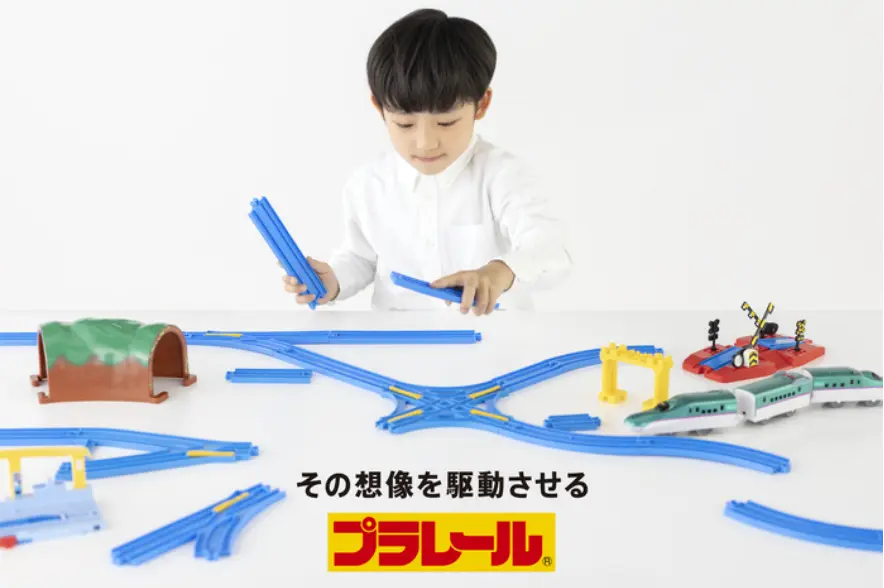














At the National Rehabilitation Center for Persons with Disabilities in Tokorozawa, Saitama Prefecture, children who lost their hands at a young age, as well as those born without hands or arms due to congenital upper-limb deficiencies can receive training using a myoelectric prosthetic hand. How do they train? Over a period of more than 10 years, children at the Center have practiced using PLARAIL through Asobi, TOMY’s popular railway toy. In this feature, Takashi Nakamura, a prosthetist and orthotist, and Asami Kimura, an occupational therapist at the Center, share the story behind why PLARAIL was chosen from among many possible toys and explore how play can enhance the well-being of children with upper-limb disabilities.


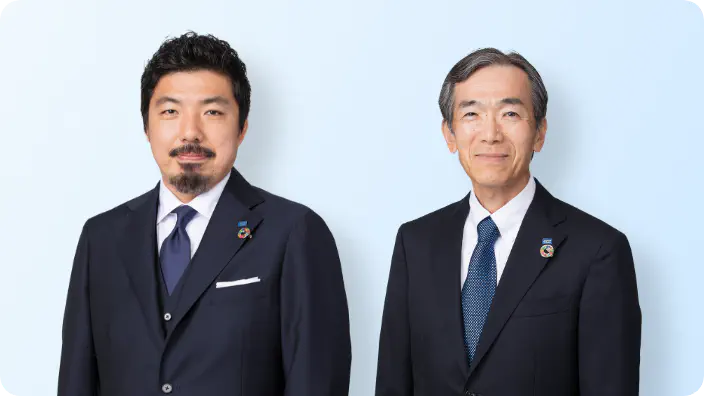
Takashi Nakamura
Department of Prosthetics and Orthotics Research Institute,
National Rehabilitation Center for Persons with Disabilities
Mr. Nakamura embarked on a career as a prosthetist and orthotist after a stint at a photography-related manufacturer. While pursuing research and fabrication of prosthetic limbs tailored for ease of use, Mr. Nakamura also plays the role of an evangelist, promoting the results of his work.

Asami Kimura
Department of Rehabilitation Hospital,
National Rehabilitation Center for Persons with Disabilities
Ms. Kimura works as an occupational therapist assisting people with physical and cognitive disabilities in their rehabilitation. She currently helps them practice to recover function and reintegrate into society.

National Rehabilitation Center for Persons with Disabilities
The National Rehabilitation Center for Persons with Disabilities, where they work, is a core institution for rehabilitation in Japan. The Center consists of six departments. In addition to the Research Institute, where Mr. Nakamura is posted and the Hospital where Ms. Kimura works, these include the Rehabilitation Services Bureau, which supports return to everyday life and preparation for employment; the College, which trains specialists for work in medicine and rehabilitation; the Department of Planning and Information; and the Department of Administration. “A Comprehensive facility like this, offering everything from specialist education to patient support, is rare, even looking worldwide,” says Mr. Nakamura.
 The importance of integrating Asobi into training
Could the two of you start by telling us about your work and your roles here?
I’m a prosthetist and orthotist. My job is to make prostheses for people who have lost limbs and make sure they fit comfortably and accurately. Fabricating prostheses requires not only skill in making them but also skill in fitting, adjusting each prosthesis down to the millimeter to ensure they fit perfectly.
As an occupational therapist, basically I support individuals with disabilities in regaining independence by helping them practice the motions they will need to do in daily life, so they can reintegrate smoothly into society. I support not only people with physical impairments but also people with developmental disorders and higher brain dysfunction. For children with congenital limb deficiencies, I provide long-term support from infancy.
How did PLARAIL come to be a part of teaching children how to use a myoelectric prosthetic hand?

When we move our muscles, they generate electrical signals called myoelectric signals. Patients use these signals to control their myoelectric prosthetic hands. For example, if someone has lost an arm below the elbow, an electrode is attached to the remaining upper arm. This electrode picks up the faint myoelectric signal and uses it to control a motor connected to the prosthetic hand.
Learning how to use a myoelectric prosthetic hand requires consistent practice. But once the user learns to control it well, using the myoelectric prosthetic hand becomes second nature.
What led you to incorporate PLARAIL into children’s practice with their myoelectric prosthetic hands?
Previously, children used a machine called an electromyograph, which changed an LED to orange or red when a myoelectric signal was generated. But just having an LED light up isn’t much fun for young children.
We also practiced with a kind of game in which children would pick up objects in front of them one at a time and move them around. But what really captures children’s interest are toys that move. The experience of performing actions that make objects move on their own is fun and exciting for children.
When our engineers were searching for moving toys that could be used for practice, the first item they found was a railroad toy from an overseas-based toymaker. The toy was specially made for practice with myoelectric prosthetic hands, its trains and rails finely and exquisitely crafted. But they broke easily once children started playing with them. That’s when it came to us in a flash: “We’ve already got PLARAIL here in Japan!” Even young children can operate PLARAIL, and best of all, it is safe and durable. The more we talked about it, the more we liked it: Children could use PLARAIL to train on their myoelectric prosthetic hands. The Research Institute purchased some PLARAIL items and each engineer began modifying the toys to create a system that could be controlled using myoelectric signals. Actual training of children using PLARAIL began in 2013. The children took to the toys immediately. Everyone enjoyed playing with them, boys and girls alike.

This is the PLARAIL set used for training. The rails, railcars, and Gripmascon remote controller are all commercially available products (product name: “You Drive! Grip-Type Master Controller” (Japanese webpage)). At the upper right of the photo are the armband-type myoelectric sensor and the switch used to convert the myoelectric signals. At the lower right is the inside of the prosthetic hand, embedded with the electrodes used to pick up the myoelectric signals.
At about the same time, we were trying out practice using other toys, such as a radio-controlled car and a crane game. However, what really made the children’s eyes light up and grabbed their attention was the PLARAIL. It wasn’t even close. To keep the children practicing, we needed a toy that would keep their interest for more than 10 or 20 seconds. In that respect, PLARAIL had a unique appeal that kept the children engaged.
As the children continued practicing with PLARAIL, were there any reactions that surprised you?
Our original goal was merely to have the children operate the PLARAIL remotely using myoelectric signals. Yet before we knew it, some of them lowered their eye level to the height of the railway setup and started playing, directly moving the railcars with their prosthetic hands. We couldn’t help thinking, “Ah, of course this is how it turns out.”
That is why we try not to force the children to keep practicing, but instead take the time to work with them patiently. As they continued to train over a period of months, many of the children suddenly became completely absorbed in their play, using myoelectric signals for remote control. Once they were hooked, the children’s skills improved remarkably. They learned to change the trains’ direction of movement, slow them down as the trains approached the station, and stop them at exactly the right positions.
Another great advantage of PLARAIL is that the children can assemble the rails to create their own courses. This nurtures creativity, and because assembling and disassembling the rails requires both hands, PLARAIL is great for learning to use the prosthetic hand and the other hand in coordination. Moreover, playing with other children helps develop cooperation and social skills. Practicing by playing with PLARAIL is enormously beneficial for the children.
As they play and have fun, the children discover skills they didn’t know they had. It’s truly gratifying to watch.

Analog play (Asobi), such as directly moving the railcars, also improves the children’s dexterity with their prosthetic hands.
For the future well-being of the children
We understand that the National Rehabilitation Center for Persons with Disabilities set up a booth (Japanese webpage) at Expo 2025 Osaka, Kansai Japan (hereinafter, the “Osaka–Kansai Expo”), to promote awareness and adoption of myoelectric limbs for children.
We have presented at seminars for medical professionals and engineers in the past, but we had few opportunities to present our work to a general audience. So, at the Osaka–Kansai Expo, we made sure our presentation on myoelectric prosthetic hands would be fun and informative. We set up an area where visitors could try opening and closing the hand of a myoelectric prosthetic hand and using it to pile up wooden blocks and operate PLARAIL trains. Over the course of the Expo, numerous visitors tried out manipulating the myoelectric prosthetic hand and experienced firsthand how myoelectric prosthetic hands work.
For over 10 years we had been making original modifications to PLARAIL and conducting training with it for our research, but we hadn’t actively shared these efforts with the general public. When we exhibited at the Osaka–Kansai Expo, we took the opportunity to reach out to TOMY to get their authorization for the use of PLARAIL as well as advice on improving our exhibit. With TOMY’s support, we were able to convey our message of improving the well-being of children with disabilities through play on the once-in-a-lifetime global stage of the Osaka–Kansai Expo.

We set up an interactive display of a custom-built control system for PLARAIL, a commercially available toy, at the Osaka–Kansai Expo. Visitors strap a myoelectric sensor to one arm and tilt or bend their wrists to make the PLARAIL trains move forward, stop, and reverse.
Finally, what kinds of toys and play(Asobi) do you expect to see to promote the use of myoelectric prosthetic hands in children with upper-limb disabilities?

Just recently we’ve experienced a particularly memorable development. In the past, one child had been making progress in training with a myoelectric prosthetic hand, only to find it troublesome and stop using it around the time they entered primary school. However, upon entering middle school, they expressed a desire to use the myoelectric prosthetic hand again. The impetus for this change came from school activities and using a smartphone. When encouraged to think about what they wanted to do and how they could achieve their goal, the child remembered the myoelectric prosthetic hand. I’m sure that part of the reason they decided to give it another try was their positive childhood experience of having fun practicing with PLARAIL.
Practicing with the myoelectric prosthetic hand takes time; it cannot be mastered overnight. To ensure that using a myoelectric prosthetic hand is one option for children with upper-limb disabilities, it’s vital that children start training with it from a young age. I would be delighted if training with PLARAIL eventually becomes a catalyst, empowering children to discover their own potential.

Interview with the mother of S,
a boy who has been practicing with a myoelectric prosthetic hand
S is a boy who lost his left hand in the process of treatment for an illness. Now five years old, he visits the National Rehabilitation Center for Persons with Disabilities about once a month to practice using a myoelectric prosthetic hand. Now, skilled at opening and closing the hand of the myoelectric prosthetic hand, he grips the Gripmascon, manipulating its controls with his dominant right hand. He has become engrossed in practicing with PLARAIL.
“He started practicing with the myoelectric prosthetic hand to support balance between his left and right sides. We know he will need to do more things with both hands when he enters elementary school, so we’re really grateful he could start training at a young age. As parents, we want him to see the loss of his left hand not as a limitation, but as an opportunity to engage positively with society. He is a very optimistic boy, and playing with PLARAIL has shown him that he can do so many things with the myoelectric prosthetic hand. He also has a big appetite, so he often tells us he wants to shovel rice into his rice bowl by himself. With the use of the myoelectric prosthetic hand, I hope that dream will come true soon.
Naoki Kasai
General Manager PLARAIL Business Group TOMY
PLARAIL, launched over 65 years ago, is one of TOMY’s most popular products today and is a toy that nurtures children’s creativity through play. PLARAIL has inspired a wide range of Asobi, yet even I was surprised to hear that it was being used for myoelectric prosthetic hand training. Children use the prosthetic hand not only to run the railcars but also to join rails together, arrange stations and tunnels, and even to clean up their toys afterward. For all of us involved with PLARAIL, it’s enormously gratifying to see it being used in this way. Watching these children use this standard, off-the-shelf product, to practice a new skill while playing like other children, I feel that this is the kind of application we always intended for PLARAIL. Talking about how it is being used in rehabilitation makes me appreciate anew the possibilities inherent in these toys. We will continue to offer our fullest cooperation to promote children’s use of myoelectric limbs through PLARAIL.
Prosthetic arms today
A prosthetic hand is an artificial hand used to compensate for the functions of a hand lost due to an accident or illness. Prosthetic hands can be broadly divided into two types: body-powered prosthetic hands, which are controlled by moving remaining body parts such as the trunk or shoulder blades; and myoelectric prosthetic hands, which are controlled by motors or batteries, as with the myoelectric hands described in this feature. At present, there is no such thing as a universal prosthetic hand: an arm that can be mounted once and do whatever the patient wants it to do. Users need different arms for specific applications, such as eating, using the washroom, using a computer, and exercising.
Myoelectric prosthetic hands have been in practical use for half a century, yet plenty of room remains for further technical improvement to support more widespread use. “We are truly grateful to TOMY for this collaboration,” says Mr. Nakamura, “and hope it will inspire more children to try using myoelectric prosthetic hands and more engineers to cooperate with us on the development of more versatile models with greater freedom and responsiveness.”
For more details, please find below:
For independent life and social participation (Page7, Persons with Congenital Upper Limb Deficiencies)