














Human Capital Strategy based on Corporate Strategy
For the TOMY Group, the human resources involved in the creation of Asobi at domestic and overseas Group companies are important human capital, and the promotion and realization of our Group’s business strategy depend on securing, developing, and enabling the active participation of these human resources. Furthermore, we believe that working for the TOMY Group has a major impact not only on the skills and careers of our human resources, but also on their lives themselves.
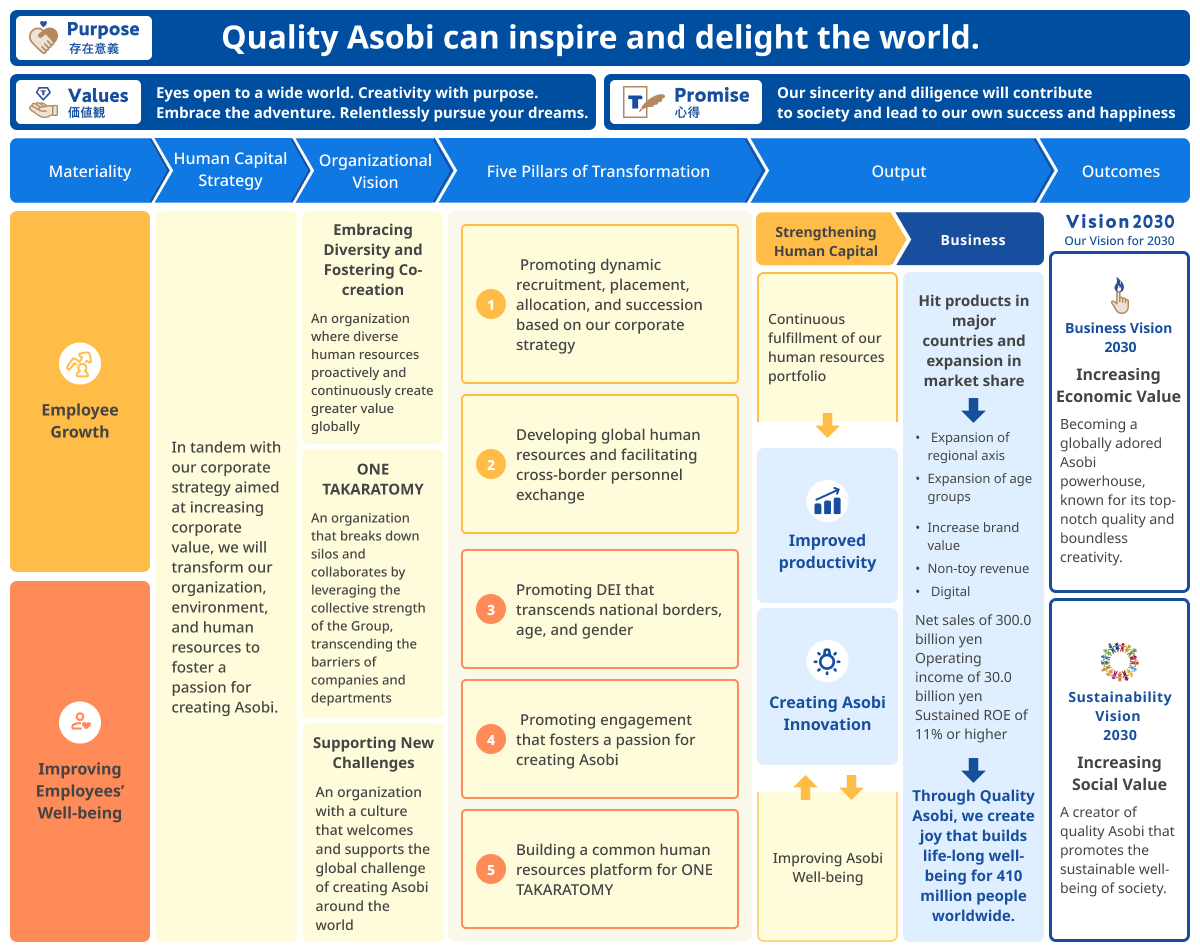
Based on this approach, and in accordance with our Purpose and Vision, the TOMY Group has established the following Human Capital Strategy and Materiality and is working to strengthen our human capital while taking risks and opportunities into consideration.
TOMY Group’s Human Capital Strategy
In tandem with our corporate strategy
aimed at increasing corporate value,
we seek to transform our organization, environment,
and human resources
to foster a passion for creating Asobi.
The TOMY Group aims to be an organization where diverse human resources in Japan and overseas proactively and continuously work to create value, generating greater results globally.
- Organizational Vision -
-
Embracing Diversity and Co-creation: An organization where diverse human resources proactively and continuously create greater value globally
-
ONE TAKARATOMY: An organization that breaks down silos and collaborates by leveraging the collective strength of the Group, transcending the barriers of companies and departments
-
Supporting New Challenges: An organization with a culture that welcomes and supports the global challenge of creating Asobi around the world
Human Capital Value Creation Story
The TOMY Group has established five pillars of transformation to realize the ideal organization outlined in our Human Capital Strategy. By working on specific measures linked to each pillar, we will not only continuously fulfill our human resources portfolio, but also promote productivity improvements and the creation of Asobi Innovation*1. This will improve employees’ Asobi Well-being*2, while further strengthening an organizational culture that achieves sustainable corporate growth.
Through these efforts to strengthen human capital, the TOMY Group will promote business strategies that expand our regional and age demographics to reach a diverse range of people. We aim to realize Business Vision 2030 (increasing economic value) and Sustainability Vision 2030 (increasing social value), thereby continuously enhancing our corporate value.

Our Policy and Strategy
Based on the above Talent Strategy Vision, the TOMY Group aims to create working environments where employees from various backgrounds, life stages, and diverse values can work with a sense of fulfillment and be absorbed in the work of creating Asobi while maximizing their performance. In addition, we work to reform work styles and systems so that each employee can continue to grow while respecting their own individuality, taking into consideration their human rights and occupational health and safety. We believe that these initiatives will lead to further improvements in the well-being of our employees.

Governance Structure
Governance Related to Human Capital
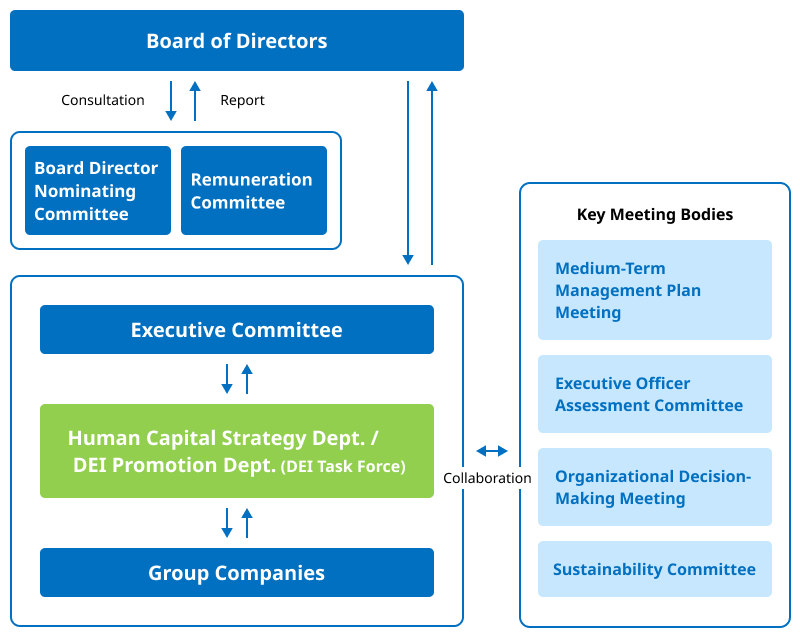
Governance related to human capital in the TOMY Group is promoted under the supervision of the Board of Directors, through a business execution system centered on the Managing Directors’ Meeting chaired by the President and CEO.
The Board of Directors receives proposals for resolution or reports on important management issues, including the Human Capital Strategy, and supervises the execution of business operations. In business execution, the Managing Directors’ Meeting, chaired by the President and CEO, deliberates and makes decisions on key matters regarding human capital, such as the Human Capital Strategy, organizational restructuring, human resource allocation, and working environment improvement, with results submitted or reported to the Board of Directors as necessary.
Furthermore, the planning and promotion of specific initiatives concerning human capital are led by the Human Capital Strategy Department and the DEI Promotion Department and are deployed across the Group in collaboration with domestic and overseas Group companies.
In addition, progress management of medium-to-long-term business strategies, evaluation and appointment of executive officers, examination of organizational strategies, and responses to sustainability and ESG issues are reported and deliberated at important meeting bodies such as the Medium-Term Management Plan Meeting, the Executive Officer Assessment Committee, the Organizational Decision-Making Meeting, and the Sustainability Committee, striving to improve the effectiveness of human capital initiatives and ensure appropriate governance.
Governance Structure Diagram

Initiatives
The TOMY Group is promoting the following five major initiatives with the aim of improving the well-being of its employees.
Improving Employee Engagement
Purpose of Employee Engagement Surveys
To realize an organization where employees can devote themselves to creating Asobi, the TOMY Group conducts employee engagement surveys to continuously track each employee’s motivation and status, and to visualize organizational challenges. This survey quantitatively tracks conditions such as employee job satisfaction, initiative, and empathy with the organization, while also identifying issues on a workplace-by-workplace basis and leading to the formulation and execution of improvement measures, aiming to build an organization that continues to grow autonomously and realize increased corporate value.
Toward this end, we are pursuing the following initiatives.
Setting Key Indicators
(Work Engagement)
We have set employees’ “willingness to contribute voluntarily” and “sense of achievement gained from work” as key indicators (work engagement) to measure the organizational state that serves as the driving force behind creating “Asobi Innovation.”
Global Rollout of the Survey
As part of “building a common platform,” we are expanding the engagement survey not only domestically but also to overseas bases, visualizing employee motivation and organizational conditions on a global scale.
Data-Driven Organizational Improvement
Survey results are disclosed to individual managers via a dashboard, leading to the identification of issues for each organization and the formulation and execution of improvement measures.
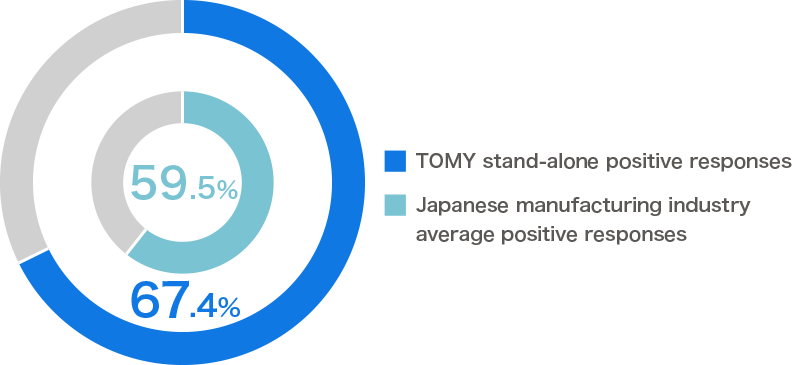
Work Engagement Score (FY2025)
- * An engagement survey is conducted by a third party (Qualtrics Japan LLC).
- * The engagement score includes items for “voluntary actions” and “positive emotions.”
- * The survey company has been changed starting from FY2025. Although the concept of “continuous increase of work engagement” set in the medium-term sustainability targets and KPIs is maintained, there are certain limitations in direct comparison with previous years due to differences in survey methodologies. We aim to drive a continuous upward trend using the current fiscal year’s results as a baseline.
- ・Starting this fiscal year, we have changed the survey system to strengthen global measurement and utilization of results.
- ・The response rate for TOMY stand-alone in FY2025 was 97% (+6pt from the previous year). This marks a record-high response rate, indicating that the employee engagement survey has become well-established among employees.
- ・The score exceeded the benchmark average for the Japanese manufacturing industry (+7pt), indicating a favorable state of engagement.
Correlation with Work Engagement Score
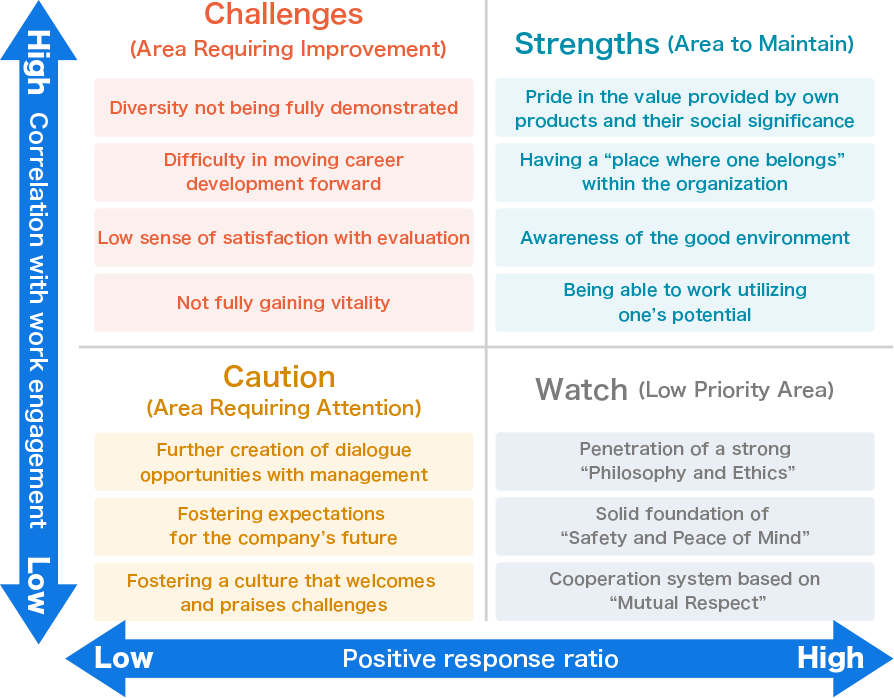
The correlation between the most important KPIs and each item is shown divided into four areas.
Items that require a particular focus for improvement are classified in the “Area Requiring Improvement” in the upper left.
- ・As top strengths, a culture of mutual respect and trust (sense of belonging, respect for individuality, and relationships of trust) has been confirmed, in addition to “attachment to our products” and “pride in social contribution.”
- ・On the other hand, items related to inclusion (co-creation), individual autonomy and growth, and well-being ranked at the top of the challenges regardless of attributes, such as “an environment where potential can be fully demonstrated,” “being able to express oneself as one is,” “meaningful career dialogues with supervisors,” “expectations of achieving goals,” and “vitality from work.” To resolve these challenges and strengthen the foundation for sustainable value creation, we will promote specific countermeasures as follows.
Actions Following the Survey
We are implementing the following actions for items identified as challenges based on the results of the employee engagement survey.
| Challenges | Soft-Side Actions | Hard-Side Actions |
|---|---|---|
| Inclusion (Co-creation) |
Organizational Revitalization MeasuresConducted team building training and group interviews with managers and employees in core positions in divisions facing challenges. Promoting Awareness ReformConducted harassment-focused training for managers, round-table discussions for female managers and employees in core positions, and introductory management training. |
Revision of the Re-employment Personnel SystemRevised the personnel system for re-employed contract employees from 2025, raising compensation to a level equivalent to that of the active generation. Enhancing “Childbirth Leave”Expanded eligibility to employees who are becoming grandparents from 2025. Introduced special leave that can be used for attending a grandchild’s birth or caring for grandchildren. |
| Personal Autonomy and Growth |
Establishing Career DialogueProvided and continued to offer opportunities company-wide to deeply discuss desired career paths and visions with supervisors using the “Career Development Sheet”. Restructuring the Education SystemExpanded training for professional skills (marketing, digital transformation, etc.) directly linked to corporate strategies and visualized and improved the quality of education through disclosures such as training satisfaction rankings. |
Expanding the Overseas Trainee SystemExpanded eligible bases and job categories from FY2026, in addition to conventional planning & development and production technology jobs, to accelerate overseas practical experience for younger employees. Next-Generation Leader DevelopmentImplemented the Global Leader Development Program targeting the management team and executive officers. |
| Well-being |
Holding TOMY Group Family DayHeld a Family Day over two days in total, inviting family members of employees including children, partners, parents, and grandchildren, to deepen their understanding of work and the workplace and to foster interaction with supervisors and colleagues. |
Favorable Leave Treatment for Mid-career HiresOperating a new system from 2026 targeting mid-career hires of regular employees, where years of external professional experience are deemed as continuous service years at the company, granting the maximum number of days of paid leave from the first day of employment. Strengthening Support Systems for Balancing Work and Family LifeComprehensively established and introduced support systems for balancing work and childcare, caregiving, and fertility treatment from FY2024. |
Promoting Diverse Workstyles Including Shortened Working Hours
So that each employee can choose diverse and flexible working styles that suit their individual lifestyles, under the jurisdiction of the human resources division, we are constructing systems and taking steps to create working environments with a sense of fulfillment.
Encouraging Flexible Work Styles
We offer flexible working environments to suit diverse lifestyles and values.
- Work-from-home system
- Super flex-time system (including those with shortened work hours)
- Second job system
- Leave of absence system for those whose partners have been transferred in Japan or overseas. When an employee's partner is transferred in Japan or overseas, the employee is allowed to take a leave of absence for up to five years, provided that the employee accompanies their partner to the partner's place of work.
Promoting Use of Paid Annual Leave
Believing that employees getting sufficient rest is an important factor that leads to improved motivation and productivity, the Group is working to create a workplace environment where it is easy to take annual paid leave.
- Paid annual leave promotion days (around 10 per year)
- Refresh day and anniversary day systems
- Monitoring of actual leave taken over the year, with follow-ups for employees who have yet to take any and their line managers
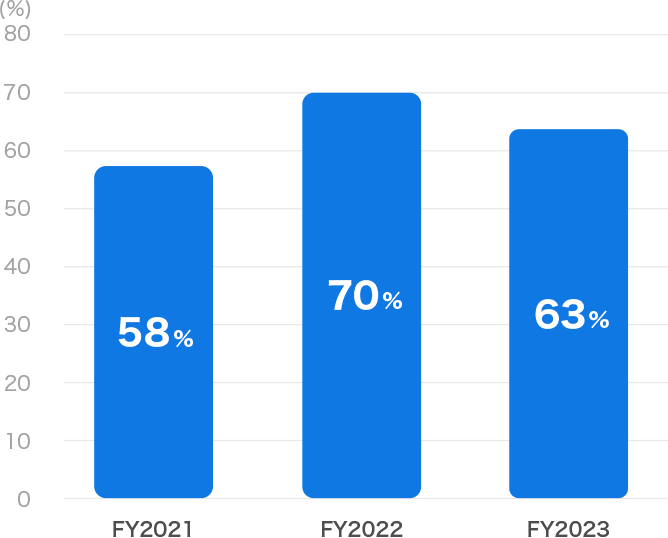
While advancing these initiatives, the annual paid leave uptake rate in FY2025 was 59%, slightly down from 62% in the previous fiscal year, and we believe further promotion is necessary.
Therefore, to ensure that mid-career hires can take leave with peace of mind from their first year, we have newly introduced a system where the period from graduation from the final educational institution to joining the company is treated as “deemed years of continuous service,” and annual paid leave is granted upon hiring according to these years. This system aims to create an environment where employees can take leave with peace of mind, taking into account that newly hired employees tend to hesitate to take leave for themselves or family reasons (such as a child falling ill) due to the low number of paid leave days granted.
Average Employee Paid Annual Leave
Utilization Rate
(Ratio of days actually taken out
of the number of granted paid leave days)
 *TOMY Company (stand-alone)
Reducing Long Working Hours
The TOMY Group conducts labor seminars for managers to help reduce overtime hours. As part of our attendance system, an email alert is sent to any employees who have worked more than 25 or 30 hours of overtime per month and their immediate managers to help reduce long working hours. We also monitor overtime hours for each individual department and staff member. Any cases of significantly long overtime are reported to the health and safety committee of the relevant Group company, and systems have been established to promote improvements involving both labor and management.
Promoting Use of Parental Leave
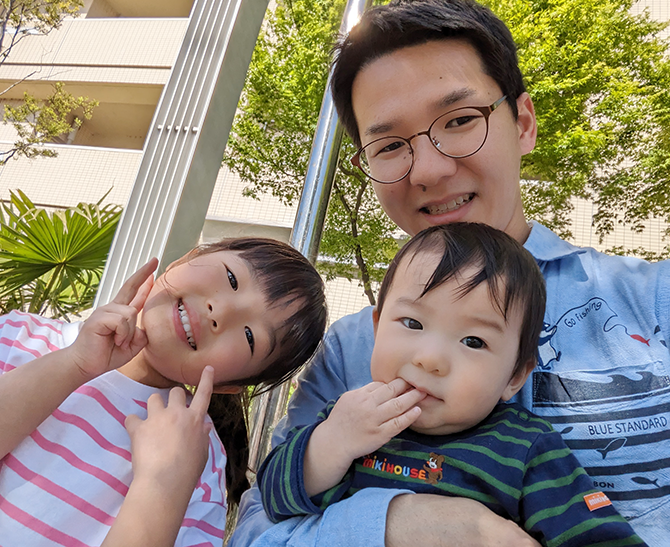
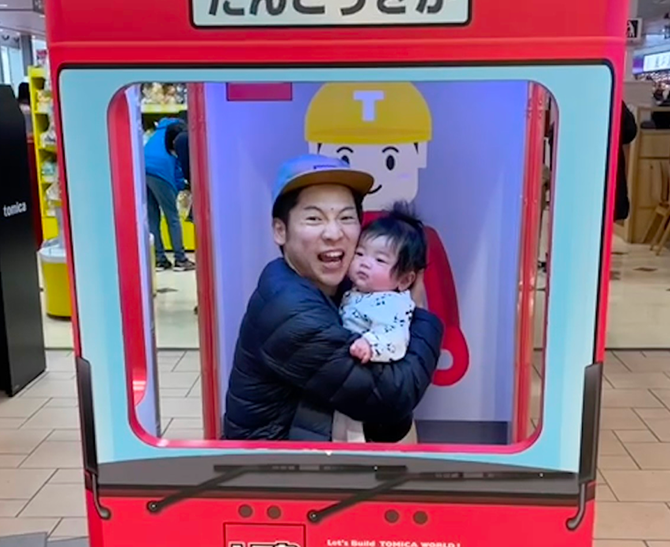
We are creating working environments where male employees can more easily take parental leave and striving to raise awareness, aiming for a 100% utilization rate.
- A support line for questions about parental leave
- Publishing of interviews in the company newsletter with male employees who took parental leave and their bosses
Male Employee Parental Leave Utilization Rate
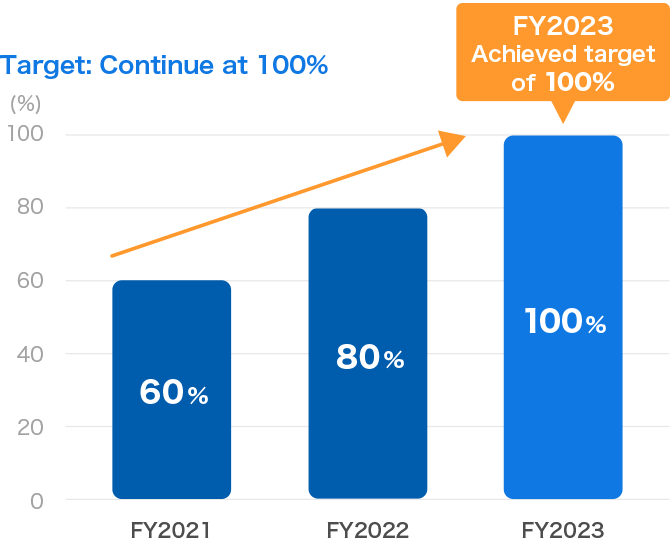 *TOMY Company (stand-alone)
*Although the leave utilization rate for FY2024 is less than 100%, employees who were unable to take childcare leave during the fiscal year took it in FY2025, making the rate effectively 100%.
*TOMY Company (stand-alone)
*Although the leave utilization rate for FY2024 is less than 100%, employees who were unable to take childcare leave during the fiscal year took it in FY2025, making the rate effectively 100%.
Initiatives to Support Work-Family Balance
In Japan, which is facing a declining birthrate and aging population, creating working environments that support a good balance between work, childcare, and nursing care has become a social issue. The TOMY Group has established a comprehensive system to support employees in balancing work, childcare, and nursing care, as well as fertility treatment.
1. New life support leave system established
We have established a leave system as a safety net that supports employees’ differing circumstances, such as childcare, caregiving, and fertility treatment, allowing everyone to continue working with peace of mind. This is unpaid leave of up to 20 working days per year from April 1 to the end of March of the following year.
2. Shorter working hour system expanded
Based on the belief that creating an environment where employees who are working while raising children or caring for family members can choose how to divide their time between work and home is crucial for them to continue their careers with peace of mind, we have reformed our shortened working hour system to expand the eligible period and shortened hours. Furthermore, we have added fertility treatment to the eligible reasons of the system to respond to the diverse life stages of our employees.
- Eligible period: Shorter working hours for childcare until the 6th grade of elementary school
- Eligible reasons: childcare, nursing care, fertility treatment
- Shortened hours: Up to 3.5 hours per days
3. New childbirth and childcare gift fund established
We provide gift money for childbirth and childcare (2 million yen per child) to subsidize childbirth expenses, childcare expenses for the future, and other expenses so that employees can raise their children with peace of mind financially. In addition, we aim to create an environment in which male employees can easily take extended parental leave by making it a condition of payment that they take parental leave for 28 days or more.
4. Introduction of Leave of Absence and Shortened Working Hours Support Allowance
Increasingly extensive support measures for balancing work and childcare, caregiving, and fertility treatment may increase the burden on other employees who cover the duties of those who use such support programs. To create an environment where employees can support those around them who are working hard to raise children or care for family members with peace of mind, we have introduced a system to provide a “support allowance” to employees who cover their duties. The support allowance is funded by approximately 30% of the salary of the employee taking leave, and is distributed to employees covering their duties.
Overall Chart of Support for Work-Family Balance
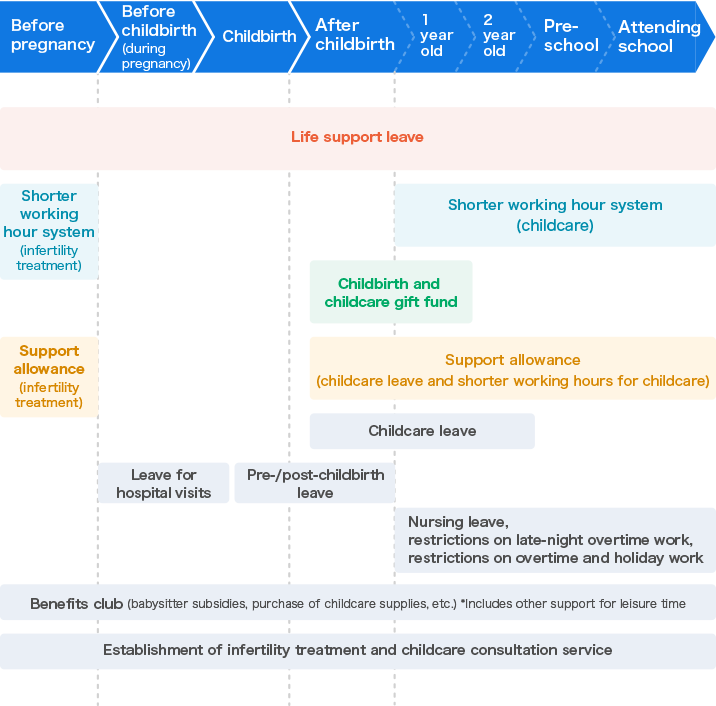 ※Some systems or initiatives are not applicable to some Group companies and employees.
We disclose rules regarding personnel evaluations and promotion requirements for employees who take leave or have reduced working hours for childcare or nursing care, and conduct fair and impartial evaluations. In addition, we inform managers of the employees concerned individually.
Creating Working Environments Where Employees Can Work Safely and Healthily
Believing that the mental and physical health and safety of each and every employee is the foundation for sustainable corporate value creation and demonstrating creativity, the TOMY Group is working to create a workplace environment where everyone can continue to work with peace of mind.
Health Maintenance & Mental Health Care
All of our employees are enrolled in social and labor insurance systems. To help maintain employee health, we have set up a Group-wide healthcare system, established a dedicated committee with occupational health physicians, and actively ensure all employees attend regular health checks, administer flu shots and prevent excessive workload. To promote positive mental health, we have created a system that gives employees access to care at any time through options such as internal and external mental health hotlines, and industrial physicians specializing in psychosomatic medicine and psychiatry.
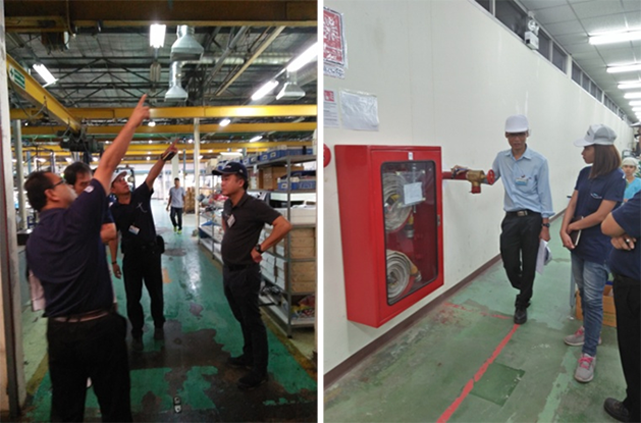
Health and Safety Initiatives at Production Bases
At production bases outside Japan that manufacture toys or other goods, employees seek to ensure factory safety and improve working environments through daily activities. TOMY Thailand has established safety leaders to play a central role in health and safety activities.
Labor-Management Relations
The TOMY Group has a single labor union in Japan, the TOMY Group Labor Union. In union dealings, we believe in the concept of labor-management cooperation and harmony whereby consistent improvement of working environments and conditions leads to positive development and growth for the Group as a whole. The labor union conveys the opinions of employees to company management and shares information with its members through monthly publications or by holding regular or ad hoc meetings. The labor union is a member of UA ZENSEN. Each Group company also concludes a labor-management agreement with fairly elected employee (worker) representatives that aims to encourage dialogue between management and employees to build strong, healthy relationships based on mutual understanding and respect.

Benefits System
We aim to create working environments where each and every employee can work with enthusiasm and peace of mind, and are working to improve working conditions and benefits.
| Statutory benefits |
|
|---|---|
|
Non-statutory
benefits |
|