










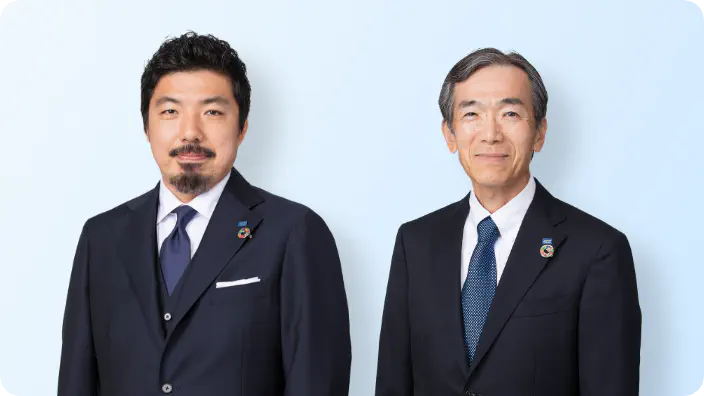




Dr. Yoshiki Ishikawa and President Tomiyama
Discuss the Value and Future of Asobi

The TOMY Group has set a target through 2030:
“Through Quality Asobi, We Create Joy that Builds Life-Long Well-Being for 410 Million People Worldwide.”
This is not merely a business target,
but a declaration embodying our desire to create happiness and connections for people through Asobi.
Why is the TOMY Group aiming to create “Joy that Builds Life-Long Well-Being” now?
Dr. Yoshiki Ishikawa, a leading researcher in well-being,
and Akio Tomiyama, Representative Director, President & CEO,
sat down to discuss the potential of Asobi, the role of corporations, and the future they envision.
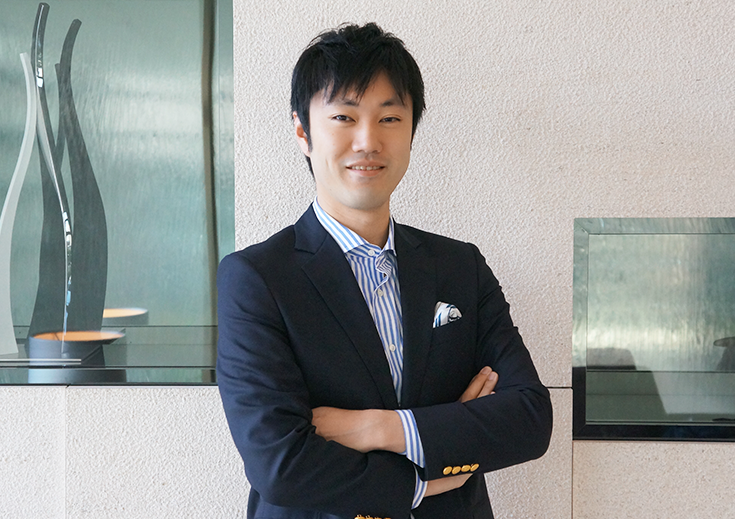
Yoshiki Ishikawa
Representative Director, Well-being for Planet Earth Foundation
Born in Hiroshima Prefecture in 1981. Graduated from the University of Tokyo Faculty of Medicine (Health Sciences), completed graduate studies at Harvard T.H. Chan School of Public Health, and received a Ph.D. in Medicine from Jichi Medical University. Under the theme of “What it means for people and the Earth to live in harmony,” he works on long-term initiatives spanning nine generations into the future (approximately 200–300 years ahead). His areas of expertise include preventive medicine, behavioral science, and the evolutionary theory of concepts.



Why “Creating Joy that Builds Life-Long Well-Being Through Quality Asobi” Now?
Tomiyama
At the TOMY Group, our 100th anniversary in 2024 prompted us to reexamine our raison d’être as a corporation, leading us to formulate our Purpose: “Quality Asobi can inspire and delight the world.” In that process, I began to wonder whether Asobi might have a much deeper social significance, and I kept asking myself, “What is Asobi’s reason for being in society?” That was when I suddenly remembered something from a lecture you gave, Dr. Ishikawa: “For human health and happiness – for well-being – human connections are indispensable.”
We sometimes deliver toys and Asobi to children’s cafeterias across Japan, and when we ask the children what they would like, games that multiple people can enjoy together, like board games, are really popular. We tended to assume that character merchandise would be what they wanted most, but in reality, that wasn’t the case at all. When we asked the staff why, they told us, “All kinds of people come to the children’s cafeterias, so they want things that allow complete strangers to start playing together right away.” What people were really looking for was, in fact, human connection.
From that point on, I began thinking deeply about well-being, and later I was fortunate to have the chance to speak with you directly, Dr. Ishikawa. At that time, you mentioned that sales figures can also be viewed as an indicator of how much a company has contributed to customer well-being, which I found fascinating. “Joy that Builds Life-Long Well-Being” is a phrase coined by our company. It expresses the concept of well-being in our own accessible way, embodying our desire to contribute to people’s health and happiness through Asobi.
Ishikawa
I have spoken in various settings about “well-being accounting,” which reframes the profit and loss (P&L) statement from the perspective of how much a company contributes to well-being. A P&L statement is fundamentally an accounting document designed to fulfill accountability to shareholders, but the idea is to look at it from a slightly different angle.
For instance, personnel expenses aren’t merely costs; they can be viewed as the “value contributed toward employees’ well-being.” Similarly, the costs incurred for procuring raw materials and goods are recorded as expenses on the P&L, but from another perspective, they can be seen as the value contributed to suppliers’ businesses and the well-being of the people working there. By incorporating the perspective of well-being, the very same figures take on an entirely different meaning. Lately, people have even begun saying that well-being is inherently a matter of finance itself.
Tomiyama
Watching children have fun playing together at children’s cafeterias made me feel that what we do creates value for people and society that goes beyond financial performance. As you pointed out, Dr. Ishikawa, when we reexamine the P&L from the perspective that every flow of money and goods in corporate activities affects someone’s well-being, our own work begins to look completely different.
Ishikawa
Looking at it that way, I think your target of “Joy that Builds Life-Long Well-Being for 410 Million People Worldwide” encompasses everyone – customers, business partners, local communities like children’s cafeterias, and shareholders alike. What does Joy that Builds Life-Long Well-Being mean for each individual, and how can Asobi contribute to that...
Tomiyama
Exactly. Setting a target with significant scale is certainly important, but what matters most is not treating that 410 million as a single monolith, but focusing on the Joy that Builds Life-Long Well-Being for each and every individual. Through Asobi, we want to genuinely engage with each child’s individual Joy that Builds Life-Long Well-Being. We never want to forget that the ones we can truly impact are always individual human beings.

The Power of Asobi
Tomiyama
Watching children play at TOMICA and PLARAIL events, or with BEYBLADE and DUEL MASTERS, I feel our hypothesis that Asobi creates connections between people was right on the mark. It is precisely because people connect with others that emotions are sparked and lasting memories are made. I believe Asobi has the power to create spaces like that.
At the same time, I believe we need to demonstrate the link between Asobi and people’s health and happiness not just through intuition, but through scientific approaches as well. We created “The TOMY Group’s Commitment” webpage, which champions “Through Quality Asobi, We Create Joy that Builds Life-Long Well-Being for 410 Million People Worldwide,” by conducting specialized surveys and engaging in dialogue with various experts to reflect their insights.
Ishikawa
I believe that things spread throughout society when the trio of “concept,” “tool,” and “practice” comes together as a set. The reason saunas have become so remarkably popular lately is that the concept of “resetting” emerged to accompany the tools and practices that were already there. Joy that Builds Life-Long Well-Being, as the true power of Asobi, may spread even further across society if symbolic concepts, tools, and practices emerge.
Tomiyama
That makes a lot of sense. We also deliver toys to disaster-affected areas, and speaking with people there, it’s clear just how genuinely toys are needed. In disaster areas, children find themselves in highly restricted environments, enduring the upheaval of life in evacuation shelters while living with the anxiety that another disaster might strike. They told us that when toys arrive and everyone plays together, the tension eases and the whole atmosphere softens. The experience of Asobi has the power to ease anxiety and create a space where people feel safe and secure. I think this connects to psychological safety.
It’s hard to find a single conceptual word to capture this importance of Asobi, but I am absolutely convinced that it is an absolute necessity.
Ishikawa
In the Japanese language, the verb “asobu” (to play) was historically used as an honorific to describe the actions of nobility.
In other words, “playing” may have been historically seen as an activity of profound prestige and value. Asobi is an act where anyone, regardless of age or status, can step away from all kinds of social constraints and let their imagination soar freely. And it is an act that allows complete strangers to connect immediately and become absorbed in something together.
Today especially, many children are exposed to competition and evaluation from an early age in schools and cram schools, constantly pressured to “be somebody.” That is why a time where you can “just be nobody in particular” – like in spaces of Asobi – is so vital, and society urgently needs to recognize its importance today. I believe your company is one of the few entities capable of addressing that need.
Global Trends in Well-Being and Corporations
Tomiyama
Physical spaces where people aren’t pressured to “be somebody” and can simply be themselves may have dwindled considerably in today’s society. For example, at events like our TOMICA Expo, no matter how excited the children get, nobody scolds them for being too loud. Such places may well have become rare and precious. Being able to create spaces where everyone can be true to themselves and immerse themselves in Asobi while maintaining safety and security through reasonable rules is perhaps one of our great strengths as a corporation.
Ishikawa
Today, we are in an age where corporate sustainability is evaluated across diverse timeframes. Day-to-day performance and corporate value are assessed through financial indicators such as P&L, EPS (earnings per share), and PBR (price-to-book ratio). On the other hand, what is emphasized when considering longer-term corporate sustainability and resilience is the ESG (Environment, Social, and Governance) perspective.
Within ESG, well-being is particularly deeply connected to the “S” (Social). How much a company contributes to society’s well-being, or how the company itself would be impacted if societal well-being deteriorates, has become one of the axes for evaluating long-term corporate value. In recent years, capital markets have also begun paying close attention to the relationship between corporate activities and well-being. In response to this movement, international disclosure frameworks for impacts, risks, and opportunities related to people and society, including well-being – such as the TISFD (Taskforce on Inequality and Social-related Financial Disclosures) – are currently being established.
Your initiative to “Create Joy that Builds Life-Long Well-Being Through Asobi” could certainly be said to be ahead of these global trends.
Tomiyama
Thank you. We consider it extremely important to clearly articulate what kind of value Asobi brings to society. The fundamental nature of Asobi hasn’t really changed between the past and today. However, just like with well-being accounting mentioned earlier, there is value that becomes visible by shifting our perspective. The act of ‘playing’ has always been such a fixture of daily life – and so taken for granted – that we rarely paused to reflect on its deeper meaning, but pursuing that inquiry is, I believe, important from a long-term perspective.
The Space of “Being Together” Created by Asobi
Ishikawa
There was a phrase spoken when relatives and friends gathered for a meal in a Hawaiian home: “We celebrate being together.” Celebrating the very fact that people are together. When I encountered that way of thinking, I felt that this might be one of the ultimate forms of well-being.
Because at work and in society, what people are usually judged on is “doing,” meaning what they have achieved. Instead, “being” allows us to celebrate the fact that someone is simply right there with you. I felt that this is precisely what well-being is, and this is the kind of world that Asobi can create.
In “The TOMY Group’s Commitment,” you set forth “high-quality absorbing experiences,” being “inspired and true to oneself,” and “delightful human connections” as the outputs provided through Asobi. Becoming absorbed and being true to oneself represent “being,” while connections between people directly embody “together.” It read to me as saying that this is truly “being together” and how you contribute to Joy that Builds Life-Long Well-Being.
Tomiyama
I see. When Asobi is translated into English, it’s usually rendered as “play,” but my gut feeling is that it encompasses far more than that. That is what “being together” is, and creating spaces where people can enter that state is perhaps our true role.
Ishikawa
Today is called the age of AI, and college students these days often say things like, “Talking to an AI is much more efficient than doing group work.” While that may be true in some respects, I believe “being together” is ultimately something that can only happen between human beings.
Of course, in living our lives, not only “being” but also “doing” is important, so being able to move back and forth between the two is perhaps what truly matters.
Tomiyama
In day-to-day management, our eyes inevitably tend to focus mostly on short-term results and economic value. Yet what has truly sustained the TOMY Group across 100 years is undoubtedly Asobi.
When we view Joy that Builds Life-Long Well-Being as something just as important as economic value, I believe how we see our businesses and our work completely changes. I feel it would be wonderful if we could talk more together about the deep meaning inherent in the act of Asobi and its true value.
We have now published “The TOMY Group’s Commitment,” but this is not the finish line: it is a fresh starting point. The more we discuss Asobi, the more new facets we seem to discover, and because that is precisely what sustainability means to us, I want to continue thinking through this moving forward.
July 24, 2026